Sacred Breeze Ministries - A Different Kind of Christian
Engaging Mindfulness, Spirituality, and Faith for Liberation and Creative Awakening

Groucho Marx famously said “I refuse to join any club who would have me as a member.” Of course Groucho Marx, being Jewish, would have been excluded from any number of organizations during most of his lifetime from the late 1800’s to the mid 20th century. Perhaps humor was his way of dealing with the prejudice and worse that he and people of his faith endured.
The truth is, being excluded hurts, whether one deals with it through humor or other means. Perhaps even worse than being excluded is being compelled to join an organization where one does not feel comfortable. Ask any aspiring female executive about feeling compelled to engage in activities or relationships to gain access to the “good old boys” network to advance their careers. Or any aspiring professional before the 1990s feeling compelled to hang out with smokers, either in haze filled rooms our outside in the cold, where the “real decisions” were made.
While perhaps not as extreme as the Spanish Inquisitions of the “enlightened” 1400’s, where torture was used to “convert” Jewish people to Christianity, these challenges were real, and equally real challenges exist in the present 2020’s. Examples include being forced to “play ball” with corrupt local, state, and federal governments to access markets and avoid penalties, or “keeping quiet” about observed and experienced abuses to avoid further personal and financial attacks. One might not expect these kinds of exclusionary and compelling forces to be factors in a nation that prides itself in opportunity, where “if you work hard, you can make it.” But, to quote Monty Python, “Nobody expects the Spanish Inquisition.”
In an ideal world, groups and organizations would be open and inviting without excluding people or compelling people to be members. And that was the point of “DEI” government and corporate policies prior to the “anti-woke” movement of the 2020’s; to break down barriers based on prejudice, to embrace “Diversity”, to encourage “Equity” and to be “Inclusive.” There are those who argue that by embracing diversity as a matter of policy, ethnic majority persons of white European descent were excluded from opportunities. Perhaps this was a fair criticism to consider, as “inclusion” applies to everyone. But instead of re-evaluating the goals of diversity, diversity, inclusion, and equity were thrown out completely, and prejudicial and exclusionary policies and practices were again put in place.
It seems that exclusion is part of human nature, discerning who is in and who is out. This makes sense when one considers the survival value of discerning friend from enemy. Whether genetically encoded or not, children are encouraged from a very young age to discern “safe family” from “stranger danger.”
But in a modern, diverse world, discerning friend from enemy is not as easy as relying on exterior clues like skin color and language, or even culture and religion. Just as there are people within all faiths, traditions, and cultures who are predatory and unkind, there are also people of all faiths, traditions, and cultures who are inclusive and kind. And even among family and friends, healthy boundaries are necessary to maintain healthy relationships. After all, no one is perfectly kind and loving all the time.
In a world where exclusion is part of human nature, where can a person turn for inclusive acceptance and even unconditional love? For persons of the Christian faith, the teachings of Jesus of Nazareth come to mind, that speak of “loving neighbor” and a Golden Rule of “treating others as we want to be treated.” In fact, all religions and cultures have similar “rules” for treating others with equity and inclusion. A few examples are shared in the image below (copied from https://scienceandmorality.com/golden-rule-in-religions/)
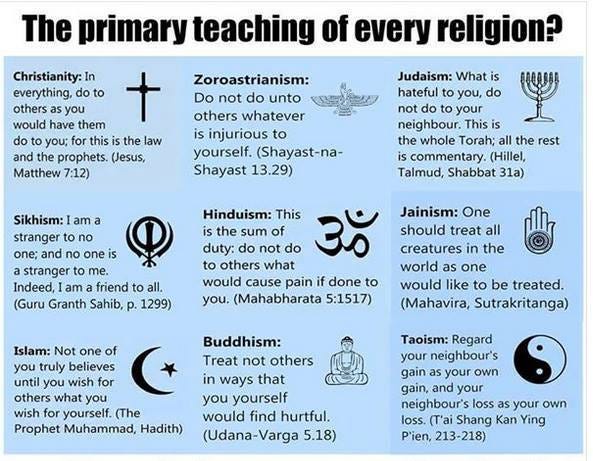
To be clear, all faiths and cultures carry traditions within that advocate inclusion, and traditions that advocate exclusion.
Within the context of Christianity, the word “Ecumenical” is used to described a Spirit of inclusion and equity. The word “Ecumenical” is often used to contrast the word “Evangelical.”
Traditionally, the word Ecumenical describes striving for cooperation rather than separation. An Ecumenical viewpoint would, for example, strive for reuniting Catholic, Protestant, and Orthodox traditions under a single, cooperative organization. One might say a “big tent.”
Ecumenical is simply a Greek word that roughly translates to “worldwide” – an analog for the Latin word catholic which means universal.
Even within Ecumenical Christianity, it seems the World and the Universe do not represent a big enough tent. “Big Tent” is often used to describe the acceptance of women in the roles of Priest and Pastor, and accepting LGBTQ persons as congregants as well as Priests and Pastors. The traditional goal of Christian Ecumenism does not even begin to address these “big tent” principles that drive divisions within traditions and denominations.
Of course, a “Biggest Tent” faith or philosophy would be truly universal, including all people, living creatures, and even the world-wide environment. Not only would a Biggest Tent theology include all people, it would embrace and even celebrate all equitable and inclusive expressions of culture, tradition, and faith.
It is magnificently ironic that monotheistic religions who worship a God who created and sustains the entire universe, including all people and all living creatures, do not openly embrace, support, or even have a name for a “Biggest Tent” theology.
Since the word ‘Catholic” commonly refers to the oldest and largest Christian organization in the world, the word “Ecumenical” can be used to transcend its traditional use of addressing Catholic, Orthodox, and Protestant traditions to include not only women and LGBTQ people, but to include all people, all life, and all of creation. So, for the purpose of this article, the term “Ecumenical Christian” applies to a specifically Christian “Biggest Tent” theology.
Which begs the question: can a “Biggest Tent” faith still retain a Christian identity? What does inclusion really mean?
If it were possible, an Ecumenical Christian would hope for a world where differences were not only tolerated, but celebrated rather than used for division and conflict. The goal would not be to convert, but rather to celebrate. That fits the Golden Rule just fine, and it sounds like a great way to love ones’ neighbors of any faith, culture, or tradition.
That may sound great for the near term, but what about the long term? What of the cornerstone points of Christian tradition, namely resurrection and, really, vindication of Christ as the ONLY physical manifestation of Divine Power? Can an Ecumenical Christian hope for an inclusive afterlife, and what would that look like? Surely every faith cannot be vindicated or proven true?
One way to approach the dilemma is to appeal to Christian Universalism. From a Universalist perspective (which has support from within Christian Scripture, but that’s the subject of many other discussions), the “truth” of “Christ’s Divine Nature” would be revealed in the healing and reconciliation of all persons and nations.
Would this signal an end to Diversity? Would all Muslims, Buddhists, and others throughout all history be compelled to surrender their faiths in favor of a Divine Christ?
One way to test the Golden Rule is to consider reversed role scenarios. If, in an end time scenario, Krishna appeared as the Divine Manifestation above all others, would Christians be compelled to surrender their faith?
All Theistic traditions believe in Divine Inspiration that speaks to individuals and communities here and now. For example, the UCC Christian Tradition has adopted the phrase “God is still Speaking.” Is God speaking to all people, or just Christians? In the past, did God speak to all people, or just Christians?
From a Christian perspective, it is obvious that God spoke through the person Jesus of Nazareth. The harder question is, did God speak through Moses? Most Christians would answer yes. Did God speak through Mohammed? That’s a harder question for Christians to answer. (Or, for some, the question is easy to answer “no.”) How about Buddha? How about Arjun in the Bhagavad Gita? And to reverse the question, is hard for Hindus, Buddhists, Muslims, and Jewish people to consider whether God spoke through Jesus of Nazareth? (Ironically, the group who would answer “yes” to that question most easily is Muslims. The Quran instructs Muslims to accept Jesus of Nazareth as a prophet, a valid purveyor of God’s instructions. As it turns out, Muslims are by design more Ecumenical that Christians, at least in the context of Judaic and Christian scriptures and believers.)
Fortunately for Ecumenical Christians, the question of who God speaks through is easily answered in Christian Scripture. The Apostle Paul in Galatians 5:22 instructs followers of Christ to “know a tree by the fruit it bears.” People who carry love, peace, patience, kindness, gentleness, faithfulness, and self-control, share the “fruits of the Spirit.”
Admittedly, not every word and action attributed to Arjun in the Gita can be described as “of the Spirit” from an Ecumenical Christian perspective. Same can be said of Mohammed and Moses. The same can even be said of Jesus of Nazareth, whose campaign of chastisement against “Scribes and Pharisees” of his time can hardly be described as patient and kind.
On the other hand, if a tree is known by its good fruits, does that mean loving, kind words shared in the Quran are Divinely inspired? In the Bhagavad Gita? In Buddhist philosophy? To an Ecumenical “Biggest Tent” Christian, the answer is yes.
If God speaks through all traditions, why bother with Christianity at all? Why not just be Ecumenical, dropping the association with Jesus of Nazareth?
For Ecumenical Christians, the words of Jesus of Nazareth inspire and even require that the path toward equity and inclusion be traveled. Jesus’s words also inspire humility and service to humanity, bringing healing and reconciliation where ever possible. And perhaps most importantly, Jesus’s demonstration of self-sacrificing love inspires followers to share his message of inclusive hope, faith, and love with the world, as has been the case since the event of his crucifixion.
While many Christians proclaim Christ’s Divinity to justify the authority of his words, Ecumenical Christians believe Christ’s words and actions prove the Divinity of his life and teachings.
One might say Ecumenical Christians believe in a “bottoms up” approach to faith, rather than “top down.” Jesus himself suggested this approach to his Disciples. When Jesus’s Disciples competed for favor, Jesus said “Whoever wants to be first must be last of all and servant of all.”
These are the words that Ecumenical Christians connect with. Humble service, loving neighbors, and treating others as they would be treated. Enjoying the Spiritual Gifts of Hope, Faith, and Love, and sharing the Spiritual Fruits of love, peace, patience, kindness, faithfulness, gentleness, and self-control.
As for any promise of eternal reward? Jesus also said “So do not worry about tomorrow, for tomorrow will bring worries of its own. Today’s trouble is enough for today.” While an Ecumenical Christian will not deny the possibility of resurrection and eternal reward, resurrection and reward are not of primary importance.
One simple test to discern whether a person carries an Ecumenical theology is to ask the question no Christian wants to consider: What if Jesus was only human, and the promise of resurrection to glory is not real? While many Christians would not even consider the question, an Ecumenical Christian will easily reply that nothing would change. Christ’s words and self- sacrificing love still provide the inspiration to serve and bring healing and reconciliation where ever possible, here and now. For an Ecumenical Christian, there is no other way.
For Ecumenical Christians, a life of service inspired by Christ’s self-sacrificing love is sufficient, just as the troubles of today are sufficient without worrying about tomorrow.
To summarize, both excluding people from and compelling people to participate in relationships and organizations violates the “Golden Rule” that was shared by Jesus of Nazareth. And some form of the Golden Rule has been proclaimed and embraced by every major religious and philosophical tradition in some form. In an ideal world, groups and organizations of all kinds would be open and inviting without excluding people or compelling people to be members.
A “Biggest Tent” Ecumenical Christian theological perspective would respect Christ’s admonitions to love neighbors and treat others as we would be treated. An Ecumenical Christian perspective responds to the words and the self-sacrificing love of Jesus of Nazareth with service to all of creation, sharing the fruits of the Spirit, and cultivating healing and reconciliation wherever possible. An Ecumenical Christian is inclusive and equitable toward all persons, all living creatures, and all of creation. An Ecumenical Christian celebrates Diversity in all its beauty, including diversity of faith, culture, and tradition. As for Resurrection that vindicates Christ’s Divine Rule, an Ecumenical Christian would suggest letting the mysteries of the future unfold as they will, for the challenges we experience are sufficient for today.
Amen.
Post Script: If you like this content and would like more information, please consider connecting with Sacred Breeze Minstries at https://www.sacredbreeze.org. You can also find us on Substack, Facebook, BlueSky, and Youtube. And have a blessed day!